

Trados Studio incredibly slow
27. Mai. 2013 In categories:Technical
Someone sent me a TTX file to translate and it took two and a half hours to prepare in Trados Studio. In fact it never quite finished. The problem was Microsoft Security Essentials (accessible from the Start menu in Windows 7). Choose the Einstellungen tab, select Echtzeitschutz and deactivate it to restore normal performance. Who wrote that software!
0 Comments
Schraubtechnik
14. Mai. 2013 In categories:Words
I had a job recently with one subject - Schraubtechnik. Dict and Linguee agree that this translates as "screwdriving technology". OK so here we have Technik again, which I have already whinged about. But, if you search for Schraubtechnik, you can even find a URL including the word. This particular web site shows very nicely what German engineers understand by this term and it is means tools to screw things together.
The manual tools to screw things together are:
Schraubenzieher - a screwdriver.
Schraubenschlüssel - a spanner or wrench.
For an English speaking engineer one tool is for a screw, the other for a nut (or the hexagonal head of a bolt): screwdriver and nut driver respectively.
This means that from the cloud of meaning associated with Schraubtechnik, only a fraction of its meaning has appeared in the "screwdriving technology" translation. Try asking a car mechanic to undo the wheel nuts on your car's wheels using a screwdriver and see what they say!
You can get in quite screwed up thinking about all this so I ended up using screwdrivers & nut drivers for my translation instead of "screwdriving technology".
The manual tools to screw things together are:
Schraubenzieher - a screwdriver.
Schraubenschlüssel - a spanner or wrench.
For an English speaking engineer one tool is for a screw, the other for a nut (or the hexagonal head of a bolt): screwdriver and nut driver respectively.
This means that from the cloud of meaning associated with Schraubtechnik, only a fraction of its meaning has appeared in the "screwdriving technology" translation. Try asking a car mechanic to undo the wheel nuts on your car's wheels using a screwdriver and see what they say!
You can get in quite screwed up thinking about all this so I ended up using screwdrivers & nut drivers for my translation instead of "screwdriving technology".
Just one sentence in Trados
07. Feb.. 2013 In categories:Technical
Disappointed with an app in SDL OpenExchange called T-Window, which doesn't work. I wondered how I could translate the odd sentence, from emails, customer's own database etc. without having to save the text as a file, read the file into Trados, to translate with the full benefit of the translation memory and terminology database.
Well, then I read that SDL Trados Studio 2011 SP2 has introduced “edit source”. Taraaah! Now there is a way to do it!
Well, then I read that SDL Trados Studio 2011 SP2 has introduced “edit source”. Taraaah! Now there is a way to do it!
- Create a Word file and use copy and paste to enter 1000 lines each containing just a full stop.
- In Trados create a project as usual with TM and Termbank and with the full stop file to be translated.
- In the Trados editor window you will now see a very boring screen with dots down the left column and nothing in the right column.
- Put your cursor in one of the "empty lines" and press alt F2 ( or use the context menu via a right mouse click).
- Enter the text to be translated into the source box, deleting the dot if you don't need it.
- Click in the right box and translate, confirm to add to the TM.
- Copy your translation and paste it where it's supposed to go.
- When you get to 1000, start again with a new file.
SAP
04. Jan.. 2013 In categories:Technical
I have quite a large job to do for SAP and I asked for terminology. They used to sell a CD but now they just say look at https://help.sap.com - which is fine but SAP do not link their English and German pages, although they are frequently available in pairs.
Eventually, I found that:
Groovy huh? I asked the SAP support person if they couldn't spend 5 minutes to add an automatic link, I got the "I am so sorry" response. SAP employ 55,765 FTEs (that's people to you and me). arf, arf, arf, arf, arf. Anyway hope this helps a bit.
Update!
In the meantime, some of the pages now have a language select box, which makes life a little easier. Unfortunately the search logic on the SAP site restricts the results to the language currently selected, so you have to remember to change the language back to German before you look for anything else. Google's search is smarter and finds more hits.
Eventually, I found that:
- if you click on Kim's magical SAP link and replace XXX in the box at the top of the page with the German term you are looking for, you will be offered a choice of SAP help pages.
- Open the one that looks promising and you will find German text which helps you to understand what they are talking about.
- If you find DE in the address shown by your browser and replace it with EN, you will usually (not always) be shown an SAP-approved translation.
Groovy huh? I asked the SAP support person if they couldn't spend 5 minutes to add an automatic link, I got the "I am so sorry" response. SAP employ 55,765 FTEs (that's people to you and me). arf, arf, arf, arf, arf. Anyway hope this helps a bit.
Update!
In the meantime, some of the pages now have a language select box, which makes life a little easier. Unfortunately the search logic on the SAP site restricts the results to the language currently selected, so you have to remember to change the language back to German before you look for anything else. Google's search is smarter and finds more hits.
English words which it would be nice to have
07. Dez.. 2011 In categories:Day to day translation
Some things in German are so useful you do wonder why there is no equivalent in English. In German there is this pair of words überschreiten and unterschreiten. Beautifully symmetrical and quite comprehensible. One goes up and the other comes down.
Überschreiten is easy, "exceed" is a good translation although you will find quite a few other suggestions
If you look up unterschreiten, you get
I like "deceed", even if it's not English. Goodness only knows which creative soul popped that one into dict.cc. (See weaknesses of online dictionaries).
Maybe it reflects some sort of foolish optimism, the economy will always grow and expectations will always be exceeded, so there is no need for a word to describe the reverse?
Überschreiten is easy, "exceed" is a good translation although you will find quite a few other suggestions
- to stride
- to outrun
- to overrun
- to overstep
- to trespass
- to overshoot
- to transcend
- to transgress
- to cross [a canal]
- überschreiten [Termin]
- to overstay
If you look up unterschreiten, you get
- to deceed [neologism (disputed): opposite of exceed]
- to fall below
- to fall short off
- to go below
- to underrun
- to undershoot
I like "deceed", even if it's not English. Goodness only knows which creative soul popped that one into dict.cc. (See weaknesses of online dictionaries).
Maybe it reflects some sort of foolish optimism, the economy will always grow and expectations will always be exceeded, so there is no need for a word to describe the reverse?
Why I hate abbreviations
23. Nov.. 2011 In categories:Day to day translation
Today I had to translate Nur wenn mit VKE 1 belegt, finden Aktionen im FC statt.
The Ingenieur is so familiar with this, that he/she doesn't hesitate for an instant when asking for a translation. Naturally there was zero context, just the name of the company and my suspicion that it is a comment in some code for numerically controlled machine tools.
I researched and found nothing. Half an your later I was searching for something else and stumbled across a forum entry where VKE was explained as Verknüpfungsergebnis. Taraa! The forum also contained some mockery of the person who asked the question along the lines of, "you call yourself a professional and you don't know what VKE stands for".
I could cheerfully strangle adherents of that philosophy. Why can't documentation be comprehensible? What is the point otherwise?
Well if you are still interested, I could then correct my translation to
"Only if at logical 1, will action be taken in the FC"
No, I don't know what FC is, I guess that it's function call……..
The Ingenieur is so familiar with this, that he/she doesn't hesitate for an instant when asking for a translation. Naturally there was zero context, just the name of the company and my suspicion that it is a comment in some code for numerically controlled machine tools.
I researched and found nothing. Half an your later I was searching for something else and stumbled across a forum entry where VKE was explained as Verknüpfungsergebnis. Taraa! The forum also contained some mockery of the person who asked the question along the lines of, "you call yourself a professional and you don't know what VKE stands for".
I could cheerfully strangle adherents of that philosophy. Why can't documentation be comprehensible? What is the point otherwise?
Well if you are still interested, I could then correct my translation to
"Only if at logical 1, will action be taken in the FC"
No, I don't know what FC is, I guess that it's function call……..
Überflüssig?
02. Okt.. 2011 In categories:Style
Today's curiosity was from a manual about some electronic circuit.
Zusätzlich können die Signale /IOWR und /IORD zeitlich verzögert werden.
Which I translated as
"The /IOWR and /IORD signals can also be delayed."
The question is do I need the translation of zeitlich? If something in delayed, it always involves time, so why bother with zeitlich, which is surely unnecessary, even in German?
But then again, maybe that's a boy's way or looking at it, to use the least number of words possible. My old headmaster once wrote in a school report "his tendency to brevity may prejudice his future chances…". Well, the less keys I have to press the quicker the job is done and the better my hourly rate...
Zusätzlich können die Signale /IOWR und /IORD zeitlich verzögert werden.
Which I translated as
"The /IOWR and /IORD signals can also be delayed."
The question is do I need the translation of zeitlich? If something in delayed, it always involves time, so why bother with zeitlich, which is surely unnecessary, even in German?
But then again, maybe that's a boy's way or looking at it, to use the least number of words possible. My old headmaster once wrote in a school report "his tendency to brevity may prejudice his future chances…". Well, the less keys I have to press the quicker the job is done and the better my hourly rate...
Absent nouns
23. Aug.. 2011 In categories:Day to day translation
Here's a good example -
Das Zentrieren und Verriegeln erfolgt über Führungsbolzen und Verriegelungseinheit.
I have already whinged about the use of erfolgen, so I will ignore that. Here is my translation
"Tools are centred and locked by locating pins and a locking unit."
The interesting bit is where does "Tools" come from. Werkzeug does not appear in this sentence, nor in the one above it if the truth be told. It is in the context, which translators are supposed to keep in their head. This means you not only have to chunter through sentence by sentence, as encouraged by the use of translation software. You have to understand what the document is covering and fill in the absent nouns.
I suppose you could translate it as
"Centring and locking is done by locating pins and a locking unit"
but I feel uneasy with that. Exactly what is centered and locked?
For the engineer who wrote the documentation it was obvious, so he/she didn't bother to write it down. I often feel that something is missing. I have not yet made my mind up whether it is idle engineers or something fundamental about German. It seems to contradict repeated noun use, which is surely a tendency in the other direction...
Das Zentrieren und Verriegeln erfolgt über Führungsbolzen und Verriegelungseinheit.
I have already whinged about the use of erfolgen, so I will ignore that. Here is my translation
"Tools are centred and locked by locating pins and a locking unit."
The interesting bit is where does "Tools" come from. Werkzeug does not appear in this sentence, nor in the one above it if the truth be told. It is in the context, which translators are supposed to keep in their head. This means you not only have to chunter through sentence by sentence, as encouraged by the use of translation software. You have to understand what the document is covering and fill in the absent nouns.
I suppose you could translate it as
"Centring and locking is done by locating pins and a locking unit"
but I feel uneasy with that. Exactly what is centered and locked?
For the engineer who wrote the documentation it was obvious, so he/she didn't bother to write it down. I often feel that something is missing. I have not yet made my mind up whether it is idle engineers or something fundamental about German. It seems to contradict repeated noun use, which is surely a tendency in the other direction...
Bedienelement
Sometimes you just have to simplify things. Today I bumped into Bedienelement and the "mandatory" terminology entries included operating part, operating control, operating element.
I had to think back to an old film I once saw where Doris Day is on a flight and the pilot dies or is otherwise incapacitated and she has to land the plane herself. Can you imagine what a laugh it would have been if the air traffic controller in the tower had said to her "You will have to take the operating elements and land the plane yourself". That would not have been good for her career!
The correct translation for Bedienelemente is controls. Basta!
I had to think back to an old film I once saw where Doris Day is on a flight and the pilot dies or is otherwise incapacitated and she has to land the plane herself. Can you imagine what a laugh it would have been if the air traffic controller in the tower had said to her "You will have to take the operating elements and land the plane yourself". That would not have been good for her career!
The correct translation for Bedienelemente is controls. Basta!
The wonder of Wikipedia
26. Juli. 2011 In categories:Day to day translation
Today I was confronted with Eigengeschäfte and found "business for own account or "trade for own account" in a number of the common online dictionaries. That didn't really sound convincing so I used Wikipedia to sort it out.
Google found this page https://de.wikipedia.org/wiki/Eigenhandel
and lo and behold, there is a nice blue underlined "english" link at the side to take us here https://en.wikipedia.org/wiki/Proprietary_trading
The content of these two articles matches, so schwuppdiwupp I've got a decent translation "proprietary trading".
And that is the Wonder of Wikipedia. Don't you just love it!
Google found this page https://de.wikipedia.org/wiki/Eigenhandel
and lo and behold, there is a nice blue underlined "english" link at the side to take us here https://en.wikipedia.org/wiki/Proprietary_trading
The content of these two articles matches, so schwuppdiwupp I've got a decent translation "proprietary trading".
And that is the Wonder of Wikipedia. Don't you just love it!
Nouns or verbs
06. Juli. 2011 In categories:Style
Germans often much prefer a noun where us English folk would use a verb. Like in Soll Generatorupdate durchgeführt werden? You could say
“Should the generator update be carried out?” - Not so good
It would be more English, not to mention shorter, i.e. less typing, to say
“Should the generator be updated?” - Better
If you munch your way through a German sentence translating word by word, it is sometimes irresistible to swap verbs for verbs and nouns for nouns. It’s like driving long distances, most of your brain switches off and only those parts required to get you where you are going stay active. At the end of the day, on your 2000th word, who could blame you? Not me, I do it all the time, but if I “wake up” and notice, I do try to pop back and fix it.
“Should the generator update be carried out?” - Not so good
It would be more English, not to mention shorter, i.e. less typing, to say
“Should the generator be updated?” - Better
If you munch your way through a German sentence translating word by word, it is sometimes irresistible to swap verbs for verbs and nouns for nouns. It’s like driving long distances, most of your brain switches off and only those parts required to get you where you are going stay active. At the end of the day, on your 2000th word, who could blame you? Not me, I do it all the time, but if I “wake up” and notice, I do try to pop back and fix it.
*
I was watching the footie after my 2000th word yesterday and the commentator came out with Stürmerfoul. I couldn't resist googling that one and sure enough two popular online dictionaries translate that as "offensive foul" LOL. Like I say nouns are much preferred and us translators ought to kick some of them firmly into touch!
Possessive pronouns
05. Juli. 2011 In categories:Style
Sometimes to make things more English, you have to add things that aren’t in the original German text.
How about Eilanfragen an den Technischen Kundendienst richten. That is pretty typical and you could translate that as “Please address urgent enquiries to the technical customer service department.” A genuine Englishman (fee, fo fi fum, I smell the blood of ...) would however say “Please address urgent enquiries to our technical customer service department.”
It’s the same with fingers and thumbs and other bits of your body. When I complained to my German wife that she says das Haar instead of mein Haar, she just replies well of course it’s my hair, whose else would it be?
Maybe it has to do with the big Du/Sie question? Is the person you are writing to a mate or not? Fortunately everyone is a mate in English, so there is no dithering associated with a choice.
Anyway, I have learned my lesson and I try to sprinkle possessive pronouns liberally about, despite the fact that they are used much less frequently in German.
How about Eilanfragen an den Technischen Kundendienst richten. That is pretty typical and you could translate that as “Please address urgent enquiries to the technical customer service department.” A genuine Englishman (fee, fo fi fum, I smell the blood of ...) would however say “Please address urgent enquiries to our technical customer service department.”
It’s the same with fingers and thumbs and other bits of your body. When I complained to my German wife that she says das Haar instead of mein Haar, she just replies well of course it’s my hair, whose else would it be?
Maybe it has to do with the big Du/Sie question? Is the person you are writing to a mate or not? Fortunately everyone is a mate in English, so there is no dithering associated with a choice.
Anyway, I have learned my lesson and I try to sprinkle possessive pronouns liberally about, despite the fact that they are used much less frequently in German.
Maske
04. Juli. 2011 In categories:Words False friends
The real translation however comes from Bill Gates, which is “window”. That does not translate as Fenster in German (something to lean out of when watching the world go by). German software engineers seem to have agreed that this is a Maske, presumably in that sense of hiding lots of data and only showing the important stuff.
Beachten
01. Juni. 2011 In categories:Words
Sometimes it takes a long time until you see the right translation for a word.
For ages I have been translating beachten with “note”. Today I bumped into someone else’s translation, using “heed”. I didn’t exactly bang my hand against the side of my head as I wear glasses and it might hurt, but I did think, duuuuh, dummy.
“Note” feels so passive, just look at that, you don’t need to do anything. I know that heed sounds somewhat old fashioned (yourdictionary offers this “heed ye this counsel that ye may obtain the fruit of holiness from the tree of wondrous glory”), but it does have that active sense of, you must obey. Heed the safety instructions, don’t just note them.
For ages I have been translating beachten with “note”. Today I bumped into someone else’s translation, using “heed”. I didn’t exactly bang my hand against the side of my head as I wear glasses and it might hurt, but I did think, duuuuh, dummy.
“Note” feels so passive, just look at that, you don’t need to do anything. I know that heed sounds somewhat old fashioned (yourdictionary offers this “heed ye this counsel that ye may obtain the fruit of holiness from the tree of wondrous glory”), but it does have that active sense of, you must obey. Heed the safety instructions, don’t just note them.
Dichtheit
06. Mai. 2011 In categories:Words
Dichtheit is a funny one. Well I almost always laugh when I see it translated at “leaktightness” or sometimes “leakage-tightness”, it’s better to laugh than to cry.
This reminds me of the glass which is 50% full. Is it half empty or half full? Well German engineers do not expect leaks, so they check for Dichtheit. English engineers do expect leaks, so that is what they look for. Remember great British motor-bikes, even when brand new in showrooms they used to put metal trays out to catch the oil dripping from the (foolishly) vertically split gearbox casings.
I translate Dichtheit using leak embedded in a suitable sentence!
This reminds me of the glass which is 50% full. Is it half empty or half full? Well German engineers do not expect leaks, so they check for Dichtheit. English engineers do expect leaks, so that is what they look for. Remember great British motor-bikes, even when brand new in showrooms they used to put metal trays out to catch the oil dripping from the (foolishly) vertically split gearbox casings.
I translate Dichtheit using leak embedded in a suitable sentence!
Geber
06. Mai. 2011 In categories:Words
Maybe it’s because I worked in electronics for many years that I find the translations of Geber and its compound forms a bit annoying.
Today I bumped into Temperaturgeber, which my predecessor had translated as “temperature transmitter”. Sometimes you get “temperature sender”. They both express this idea of generosity. The kind sensor is giving you the value that it measured and, for German speakers, the important aspect emphasised in the word is the giving.
Well, English engineers are more interested in the sensitive side of things, what’s important to us is the sensing, so we call it a “sensor”, whether you are given the value or it is transmitted to you is of secondary interest, it is what it senses that’s important to us.
Today I bumped into Temperaturgeber, which my predecessor had translated as “temperature transmitter”. Sometimes you get “temperature sender”. They both express this idea of generosity. The kind sensor is giving you the value that it measured and, for German speakers, the important aspect emphasised in the word is the giving.
Well, English engineers are more interested in the sensitive side of things, what’s important to us is the sensing, so we call it a “sensor”, whether you are given the value or it is transmitted to you is of secondary interest, it is what it senses that’s important to us.
Kraftschlüssig
03. Mai. 2011 In categories:Words
There is a pair of words kraftschluss and formschluss. (German Wikipedia article) These tidily express the (contrasting) ideas of passing force from one object to another by the use of friction or shape. For example, friction would be putting your finger on a piece of paper on your desktop and sliding it along. Shape would then be sticking the same finger in the handle of your tea cup to pick it up.
I found this sentence today.
Beim Ansprechen der Sicherheitsabschaltung bleibt jeweils die vorher eingeschaltete Gangstufe kraftschlüssig.
The contrast which these two words are meant to express is missing from this situation. What do you do? Use “friction locked” for kraftschlüssig? That would sound seriously weird to an Englishman. Do you assume that what the engineer meant was the previously unmentioned friction clutch remains connected. Or do you assume that the engineer just liked the word and stuck it in inappropriately?
Someone accused me of being a smart arse the other day for being so picky about the use of words. Or in this case, deciding that the engineer’s choice of words was poor and that I supposedly know better, although I have never seen the machine described? Well I am a smart arse, so this is what I did with kraftschlüssig.
If this safety cut-out trips, the previously engaged gear will remain engaged.
I found this sentence today.
Beim Ansprechen der Sicherheitsabschaltung bleibt jeweils die vorher eingeschaltete Gangstufe kraftschlüssig.
The contrast which these two words are meant to express is missing from this situation. What do you do? Use “friction locked” for kraftschlüssig? That would sound seriously weird to an Englishman. Do you assume that what the engineer meant was the previously unmentioned friction clutch remains connected. Or do you assume that the engineer just liked the word and stuck it in inappropriately?
Someone accused me of being a smart arse the other day for being so picky about the use of words. Or in this case, deciding that the engineer’s choice of words was poor and that I supposedly know better, although I have never seen the machine described? Well I am a smart arse, so this is what I did with kraftschlüssig.
If this safety cut-out trips, the previously engaged gear will remain engaged.
Translation memories
25. Apr.. 2011 In categories:Day to day translation
I do some work for a very large company which has thousands of documents translated every year and they do not use a single, online translation memory (what’s that?). Most freelance translators work online these days and if we could all use exactly the same translation memory it would be great.
At the moment however, for each order, this company’s agency forwards a tiny package (produced by the company itself) of the work to be translated and maybe a reference file or two. I am not even sure if the company’s preferred tool (Transit) supports an online memory. It would be good, malicious fun to run an analysis and see how much money they waste by having the same sentences translated over and over again.
I am guessing that this is because “it’s all too complicated” just like credit default swaps, no one knows what is actually going on, or how in this case translation memories actually work. All that I know is, that I occasionally recognise sentences which I have recently translated, sitting there like old friends waiting patiently for me to translate them again.
Since I have realised what is going on, I have started keeping everything from that customer and I manually include it, so that I then don’t have to waste my own brain power on repeat translations. I still get paid for it of course.
It’s still a shame though, because this company has lots of technical bits & pieces which are hard to name in English. It would be nice, when the terminology supplied can’t help, to be able search the memory of thousands of existing translations. Then I wouldn’t have to get researching in hyperspace and reinvent the wheel, which may end up a different shape to older ones.
At the moment however, for each order, this company’s agency forwards a tiny package (produced by the company itself) of the work to be translated and maybe a reference file or two. I am not even sure if the company’s preferred tool (Transit) supports an online memory. It would be good, malicious fun to run an analysis and see how much money they waste by having the same sentences translated over and over again.
I am guessing that this is because “it’s all too complicated” just like credit default swaps, no one knows what is actually going on, or how in this case translation memories actually work. All that I know is, that I occasionally recognise sentences which I have recently translated, sitting there like old friends waiting patiently for me to translate them again.
Since I have realised what is going on, I have started keeping everything from that customer and I manually include it, so that I then don’t have to waste my own brain power on repeat translations. I still get paid for it of course.
It’s still a shame though, because this company has lots of technical bits & pieces which are hard to name in English. It would be nice, when the terminology supplied can’t help, to be able search the memory of thousands of existing translations. Then I wouldn’t have to get researching in hyperspace and reinvent the wheel, which may end up a different shape to older ones.
Visualisierung
11. Apr.. 2011 In categories:Words
I feel that I see Visualisierung translated as visualisation far too often. I mean you can see the temptation, you only have to replace half of the letters, it’s less work and it sounds just right.
The only problem is that Visualisierung mostly means display and “visualise” mostly means imagine. So while German readers are invited to look at the display to see something, English speakers are invited to imagine the same stuff.
Maybe there’s even a touch of transatlantic trouble here. The Princeton definition includes the German idea, where the Cambridge version does not. Maybe that just shows that more German speakers emigrated to the US than did to the UK, but what is a poor translator to do?
The only problem is that Visualisierung mostly means display and “visualise” mostly means imagine. So while German readers are invited to look at the display to see something, English speakers are invited to imagine the same stuff.
Maybe there’s even a touch of transatlantic trouble here. The Princeton definition includes the German idea, where the Cambridge version does not. Maybe that just shows that more German speakers emigrated to the US than did to the UK, but what is a poor translator to do?
Fa.
09. Apr.. 2011 In categories:Words
Firma is a funny one. Of course it means company.
However when a German engineer writes something like (Fa. Wordwise), you don’t do anyone any favours by translating it as (company Wordwise).
What they often mean is (made by Wordwise).
It is just that Fa. is so delightfully short and the context ought to tell you what they really mean.
However when a German engineer writes something like (Fa. Wordwise), you don’t do anyone any favours by translating it as (company Wordwise).
What they often mean is (made by Wordwise).
It is just that Fa. is so delightfully short and the context ought to tell you what they really mean.
Technik
09. Apr.. 2011 In categories:Words False friends
Technik is an unreliable if not exactly a false friend and is often inappropriately translated as technology. For example die Technik hat versagt.
Technik is not the same as Technologie. Wikipedia will help you with the difference. What would we do without Wikipedia!
I think that Technik is material and Technologie immaterial. So Technik is equipment or something else that you can bang your head against. Technologie is something that may make your brain hurt, but you won’t get bruises from it.
Technik is not the same as Technologie. Wikipedia will help you with the difference. What would we do without Wikipedia!
I think that Technik is material and Technologie immaterial. So Technik is equipment or something else that you can bang your head against. Technologie is something that may make your brain hurt, but you won’t get bruises from it.
Lieferumfang
09. Apr.. 2011 In categories:Words
Some engineers love Lieferumfang
Installation, Integration und Inbetriebnahme der Achsbereichsüberwachungen ist Lieferumfang des AN.
I’m afraid that I cringe when I see “scope of delivery” used for this. All that the poor engineer was trying to say was that the contractor is responsible for all of that.
Sometimes its even just as simple as simple as “supplied” or “included”.
Die benötigten Batterien sind im Lieferumfang enthalten.
Not “The required batteries are included in the scope of supply.” Eeeek!
But “The required batteries are included”.
Installation, Integration und Inbetriebnahme der Achsbereichsüberwachungen ist Lieferumfang des AN.
I’m afraid that I cringe when I see “scope of delivery” used for this. All that the poor engineer was trying to say was that the contractor is responsible for all of that.
Sometimes its even just as simple as simple as “supplied” or “included”.
Die benötigten Batterien sind im Lieferumfang enthalten.
Not “The required batteries are included in the scope of supply.” Eeeek!
But “The required batteries are included”.
Steckverbinder
13. Aug.. 2010 In categories:Words
I must have seen “plug connector” a million times as the translation for Steckverbinder. Sometimes more is less and an average English engineer doesn’t need or want to know whether an electrical connection is made by screwing or pushing. The presumption is that you push plugs into sockets, or in the hermaphrodite world of car electrics you simply connect the connectors. Screwing cables together would do nasty things to the wires, not to mention the impossible complexity of numerous precision slip rings that would be required for screw fit multi-way connectors.
Just connector is quite enough.
Just connector is quite enough.
Durchführen
11. Aug.. 2010 In categories:Style
Like erfolgen, durchführen is one of those dodgy “nouns are nicer” words. Look what I found the other day.
Zur Zeit wird das Sperren nur bei Frontairbageinheit Beifahrerseite durchgeführt!
this was translated as
Deactivation is currently only performed in the front airbag unit on the passenger side.
How about
Currently, only the front airbag unit on the passenger side is deactivated.
Zur Zeit wird das Sperren nur bei Frontairbageinheit Beifahrerseite durchgeführt!
this was translated as
Deactivation is currently only performed in the front airbag unit on the passenger side.
How about
Currently, only the front airbag unit on the passenger side is deactivated.
Erfolgen
11. Aug.. 2010 In categories:Style
Efolgen is one of those words which I suppose shows that Germans think that nouns are to be taken more seriously than verbs. Why would they do this otherwise?
Die Prüfungen des Airbag-Systems dürfen nur mit den dafür vorgesehenen Prüf- und Messmitteln erfolgen.
The tests of the airbag system may only be carried out with the specified test and measurement equipment.
Which you can understand, but I think this is more English.
The airbag system may only be tested with the specified test and measurement equipment.
Die Prüfungen des Airbag-Systems dürfen nur mit den dafür vorgesehenen Prüf- und Messmitteln erfolgen.
The tests of the airbag system may only be carried out with the specified test and measurement equipment.
Which you can understand, but I think this is more English.
The airbag system may only be tested with the specified test and measurement equipment.
And or logic
19. Mai. 2009
I sometimes find the German use of und and oder back to front. For example -
XXX ist nicht für die Unterbringung, Verpflegung und Transfers verantwortlich
My translation of this is
XXX is not responsible for accommodation, meals or transfers.
Which means that I am translating und as or. I do wonder what George Boole would have made of that? I suppose this goes with beziehungsweise, which is another one of those irritating words to translate with no direct equivalent in English.
XXX ist nicht für die Unterbringung, Verpflegung und Transfers verantwortlich
My translation of this is
XXX is not responsible for accommodation, meals or transfers.
Which means that I am translating und as or. I do wonder what George Boole would have made of that? I suppose this goes with beziehungsweise, which is another one of those irritating words to translate with no direct equivalent in English.
Kim's translation memory
29. Apr.. 2009 In categories:Tool feature requests
Present translation memories store pairs of sentences. Kim’s translation memory would keep that, but would also keep pairs of documents with all of the pictures and formatting. PDF format would be good, see synchronising PDF documents too. This would mean keeping far more context than is currently the case, for almost zero effort. All you need is a bit of online storage and a fast connection.
Merker
29. Apr.. 2009 In categories:Words

This reminded me of my first working meeting in German, back in 1987. I was following everything until they suddenly starting talking about “flex”, which didn’t fit into the context and I completely lost the thread. I was quite miserable about my pathetic vocabulary until it eventually struck me that they were talking about “flags”. When pronounced with an educated German accent, this sounds like “flex”...
Übersetzungstechnisch
26. Apr.. 2009 In categories:Style
Übersetzungstechnisch. finanztechnisch, schmiertechnisch, wolkentechnisch, geschmackstechnisch, mnemotechnisch, messtechnisch - the list is endless of words guilded with a magical technisch. This seems to be a question of style & does not have much to do with technicalities. Instead of writing Dokumentation über Schmierung, engineers write schmiertechnische Dokumentation. Sounds grand does that!
I translate like this - messtechnisch geschultem Personal - personnel trained in the use of measurement equipment
I translate like this - messtechnisch geschultem Personal - personnel trained in the use of measurement equipment
Plausibility checks
23. Apr.. 2009 In categories:Day to day translation Tool feature requests
Today i came across Schwerpunktstation. Both Leo and IATE call this a “distribution network core unit”. I have never heard of that, so I did the Google test and got just 1 hit from a Dutch website. So, it’s obviously not called that in the Anglo-Saxon world. I think that I will choose the closest quickly understandable term and call it a substation. Wouldn’t it be nice though if online dictionaries could do a plausibility check like this, as well as using votes from users, in a similar way to Websters Online “usage frequency” ?
Fachabteilung
21. Apr.. 2009 In categories:Words
Fachabteilung is a word to promote the importance of what us slobby English just call a department. Someone has in all seriousness called this a “speciality department” in no less than 2 online dictionaries. As a Fachmann is an expert, I suppose the idea in Fachabteilung is that the department exclusively employs experts and an Abteilung is then implicitly full of idiots?
Konstrukteur & Design
20. Apr.. 2009 In categories:Words
Wikipedia shines here. The German entry for Konstrukteur correctly provides a link to the English site’s design engineer page. The only slight problem is that these two terms only correspond for mechanical engineering. German electrical or electronic design engineers usually use Dipl. Ing. Elektrotechnik / Elektronik to fill out their business cards. See Berufsbezeichnungen. Note that Germans have adopted Design as a German word, but they currently consider it to be exclusively arty-farty. Should you get an interview as a designer at Siemens they won’t be asking you about characteristic impedance, but they may well ask what you think of Shiro Kuramata.
Tags
08. Apr.. 2009 In categories:Tools Day to day translation
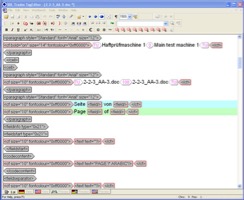
In the 1980s I was working in a research centre in London, where they had an incredibly expensive Canadian word processing system, where the secretaries needed 6 weeks of training to produce correctly formatted letters. Then we bought some Macs with WYSIWYG editors and overnight anyone could do it. 25 years later on we get tags.
Betriebsmedium

I was then entertained to read that calling a spade a spade is actually based on a mistranslation...
Protokoll
06. Apr.. 2009 In categories:Words
Protokoll is one of those words that often suffers at the hands of tired translators. Not just bashing in “protocol” requires some thought. The German Wikipedia article (Hurra for Wikipedia!) uses 1437 words to explain its various meanings. My problem is that automated German test equipment often puts test results into a Protokoll, which an English engineer of my generation calls a report. Maybe I´m too King Canute-like here and, as the tide of German-made test equipment circulates around the planet, industriously producing “protocols”, this usage may become common enough to be considered correct.
Big screen
06. Apr.. 2009 In categories:Tools Day to day translation
Terminology database temptation
06. Apr.. 2009 In categories:Tools
Sometimes, it is hard to resist the Terminology database, as in this example:
Die Referenzpunktfahrt wird nach dem Start der Maschine ausgeführt.
Failure to resist the temptation may result in something splendid like this
Die Referenzpunktfahrt wird nach dem Start der Maschine ausgeführt.
Failure to resist the temptation may result in something splendid like this
- The reference point travel will be executed after the start of the machine.
- When the machine starts, it will move to the reference point
Repeated noun use
06. Apr.. 2009 In categories:Style
I suppose that it’s an attempt to be precise, that produces sentences like this -
Instead of writing this -
Another example
- Achse mit der Hand in eine mittige Lage fahren, so dass die Achse noch mindestens 50 mm fahren kann.
Instead of writing this -
- Manually move the axis to a central position so that the axis can move at least 50 mm.
- Manually move the axis to a central position so that it can move at least 50 mm.
Another example
- Verbindungskabel am PC anschließen
- Connecting the connection cables to the PC
- Connecting the cables to the PC
Crossword puzzles
06. Apr.. 2009 In categories:Day to day translation
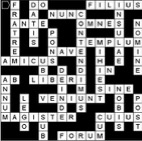
Unfortunately, this only works if the whole job is to be translated. If only half is to be translated as the other half was previously translated by someone else, there is a problem. The problem is that, as a freelance translator, I only get paid for the new bits. What do you do about the “fakes” which appear in the previously translated half. I’m afraid that I feel that I have to fix them, which is pretty silly, doing unpaid work, just to have a clear conscience when I deliver.
What do you do?
Vorliegen
06. Apr.. 2009 In categories:Words

The list of suggested translations from the various online dictionaries is not too bad - to be there, to be present, to have arrived, to be available, to be existent, to be on hand, be, be available, be known. However, one to one word translations don’t always work, despite the impression that you can build up when using terminology databases. How about this nice example:
- Es liegen noch keine Ergebnisse vor.
- The results haven't come in yet.
Bearbeiter
06. Apr.. 2009 In categories:Words
Bearbeiter is one of those German words that is very unpleasant for translators into English, as it quite clearly means “the person who does the work” but that is a phrase that would make English native speakers giggle if ever any translator were foolish enough to put that in writing.
The list of suggested translations from the various online dictionaries certainly makes me giggle - adapter, reviser, arranger, compiler, processor, adaptationer (sic), issuer, originator, authorised person, authorised user, agent, editor, person in charge, one who abridges. (See a weakness of online dictionaries)
This is where you need full context to work out exactly what the customer means. I have just done an Excel word list where this appeared without any context at all. For health reasons I have stopped tearing out my hair, so I had to guess, using the name of the customer and the other individual words for context.
What do you do?
The list of suggested translations from the various online dictionaries certainly makes me giggle - adapter, reviser, arranger, compiler, processor, adaptationer (sic), issuer, originator, authorised person, authorised user, agent, editor, person in charge, one who abridges. (See a weakness of online dictionaries)
This is where you need full context to work out exactly what the customer means. I have just done an Excel word list where this appeared without any context at all. For health reasons I have stopped tearing out my hair, so I had to guess, using the name of the customer and the other individual words for context.
What do you do?
Abbreviations
06. Apr.. 2009 In categories:Tool feature requests
I am often frustrated by abbreviations in German. I suppose they are so popular as some expressions are so long in German. For example, in Berlin, everyone knows that BVG means Berliner Verkehrsbetriebe, ehemals Berliner Verkehrs (Aktien)Gesellschaft. When you have just arrived from Birmingham, it takes a while to work out what they are talking about.
What I would like is a tool that does a German spell check in a single pass, requiring no manual intervention, just producing an alphabetically sorted list of the failures. Those words that fail the spell check would include most of the abbreviations and give me a list to send to the customer at the start of the job. There is then a reasonable chance that answers would arrive before I have finished.
Of course I could just collect them manually as I work though, but that means I can’t send the list until I have finished. When I have finished, I don’t really want to go back a few days later, when the answers arrive, and open up the job again, when I am in the middle of something else.
What I would like is a tool that does a German spell check in a single pass, requiring no manual intervention, just producing an alphabetically sorted list of the failures. Those words that fail the spell check would include most of the abbreviations and give me a list to send to the customer at the start of the job. There is then a reasonable chance that answers would arrive before I have finished.
Of course I could just collect them manually as I work though, but that means I can’t send the list until I have finished. When I have finished, I don’t really want to go back a few days later, when the answers arrive, and open up the job again, when I am in the middle of something else.
Synchronise PDF documents with translation tools
06. Apr.. 2009 In categories:Tool feature requests
Context
Context is vital to produce the correct translation. Most translation tools however remove all of the context and offer a confusing jumble of tags and words from just a single sentence, the one that you are currently translating. Any pictures are stripped out, the position and role of the sentence on the page is lost as is the presentation which was carefully crafted to help you to understand the content.
The cause of the problem
This arises from the use of differing editing software to produce the original documents and the need for conversion tools to take a variety of source formats and produce one consistent format which can be understood by the translation tool. When the translation is complete, the inverse conversion is done to generate a document in the original format, ready to be opened by the original editing software.
The solution
My workaround to this is to open up a copy of the source document in PDF format. Whatever the original editing software was, if it was a document intended for printing, a PDF version can be produced at the click of a button. I copy a tag-free part of the sentence to be translated from the translation tool and search for this in the PDF document. Obviously I can’t do this for every sentence as it would take far too long.
If I can do this manually, software can do it too, and that is the feature that I would like to see in all translation tools.
Proz
06. Apr.. 2009 In categories:Tools
Serving the world's largest community of translators, ProZ.com delivers a comprehensive network of essential services, resources and experiences that enhance the lives of its members.
For years I thought that this was pronounced Protz, which Leo entertainingly translates as "swank" or "show-off". It was only recently that an American friend pointed out that it should be pronounced "prose". Giggle.
For years I thought that this was pronounced Protz, which Leo entertainingly translates as "swank" or "show-off". It was only recently that an American friend pointed out that it should be pronounced "prose". Giggle.
Google research 1
06. Apr.. 2009 In categories:Tools
Google is very clever about working out where you are and offering search results to match. This can produce misleading impressions and is sometimes hard to control. This is why I have forced Kim's little helper II  to use the UK Google when looking for English words and the German Google when looking for German words.
to use the UK Google when looking for English words and the German Google when looking for German words.Exclamation marks
06. Apr.. 2009 In categories:Style
Testbetrieb!!!Sicherheitsschalter für *IBN teilweise deaktiviert!!!
Maybe it’s just engineers who have this curious affection for exclamation marks. You don’t hear engineers speaking with this sort of vehemence. It’s as if they doubt that you will believe them in writing and that by adding more exclamation marks it increases their credibility. Maybe it’s just my British tendency to understate things.
Whatever it is, I delete almost all exclamation marks.
(*IBN is this particular engineer’s shorthand for Inbetriebnahme)
Maybe it’s just engineers who have this curious affection for exclamation marks. You don’t hear engineers speaking with this sort of vehemence. It’s as if they doubt that you will believe them in writing and that by adding more exclamation marks it increases their credibility. Maybe it’s just my British tendency to understate things.
Whatever it is, I delete almost all exclamation marks.
(*IBN is this particular engineer’s shorthand for Inbetriebnahme)
Just nouns
06. Apr.. 2009 In categories:Style
Überlastung Q13.2: Leistungsschutz Hydraulikpumpe
This sort of abbreviated German is unfortunately common. The colon serves to replace everything that is not a noun, thus avoiding any possible grammatical challenges associated with assembling a full sentence. Encouraged by agency strictures that „die Terminologie ist verbindlich!“, you could translate this as
This would score zero terminology errors and is almost comprehensible. Wouldn’t it be nice if we could actually use the context to solve the puzzle and use a few words other than nouns.
This sort of abbreviated German is unfortunately common. The colon serves to replace everything that is not a noun, thus avoiding any possible grammatical challenges associated with assembling a full sentence. Encouraged by agency strictures that „die Terminologie ist verbindlich!“, you could translate this as
- Overload Q13.2: contactor hydraulic pump
This would score zero terminology errors and is almost comprehensible. Wouldn’t it be nice if we could actually use the context to solve the puzzle and use a few words other than nouns.
- The hydraulic pump contactor Q13.2 has cut out following an overload.
Messwert
06. Apr.. 2009 In categories:Words
Messwert is one of those words where you can translate too much. Today I found „measuring value“ in the memory. In English it is just „measurement“. You don’t need value unless there is possible confusion in the context concerned about whether you are talking about the measurement process itself or the value that it produces.
Datenpflege
06. Apr.. 2009 In categories:Words
Datenpflege sounds terrific in German, you are caring for your poor data, looking after it, nurturing it, maintaining it. Translate this as "edit". Sorry, us English-speakers are cold, heartless brutes as far as data is concerned.
Hochwertig
06. Apr.. 2009 In categories:Words
Hochwertig is a really popular marketing word in German. In a technical context, I don’t think that you can often say "high value", which could be interpreted as expensive, so I usually stick "high quality" in. Maybe it’s me, what do you do?
Berufsbezeichnungen
06. Apr.. 2009 In categories:Words
This is a tricky subject. The crowning glory of years spent learning your trade for a German speaker is their job title. You will find plenty of Wikipedia articles about Berufsbezeichnungen, which shows the importance placed on this in contemporary German society. For an Englishman, this seems oddly proud and excessively precise. "Oh, I work in electronics" may be fine for a London cocktail party, but German clients will be devastated if you can’t produce an "official" translation for their job title (see berufe-lexikon) and will seriously doubt your competence.
I must however admit, that when trying to find a qualified (non-cowboy) electrician, plumber or carpenter in the UK, it would be nice if some things were as clear there as they are in the German-speaking world.
I must however admit, that when trying to find a qualified (non-cowboy) electrician, plumber or carpenter in the UK, it would be nice if some things were as clear there as they are in the German-speaking world.
Sitzriese
06. Apr.. 2009 In categories:Words German but not English

Favourite online German English dictionaries
06. Apr.. 2009 In categories:Tools
There are quite a few online German English dictionaries. None of them has all of the answers. I quite like webtranslate, for European Community stuff IATE is OK and both dict.cc and Leo have a lot of entries. Just search for „englisch deutsch Wörterbuch“ and you will find a long list of online dictionaries, or dictionary applications, some free, some not. In daily work, I use Kim's little helper II which uses all four of the above at the same time.
See the weaknesses of online dictionaries.
which uses all four of the above at the same time.See the weaknesses of online dictionaries.
Weakness of online dictionaries
06. Apr.. 2009 In categories:Tools
These days, many online dictionaries are built up by user contributions. You have to recognise that a lot of German-speakers speak English and comparitively few English-speakers speak German, and that if they do, they do not make so many contributions.
This means that online German-English dictionaries are often "polluted" by well-meaning but over-enthusiastic non-native speakers. I take a large pinch of salt with the English translations.
This means that online German-English dictionaries are often "polluted" by well-meaning but over-enthusiastic non-native speakers. I take a large pinch of salt with the English translations.